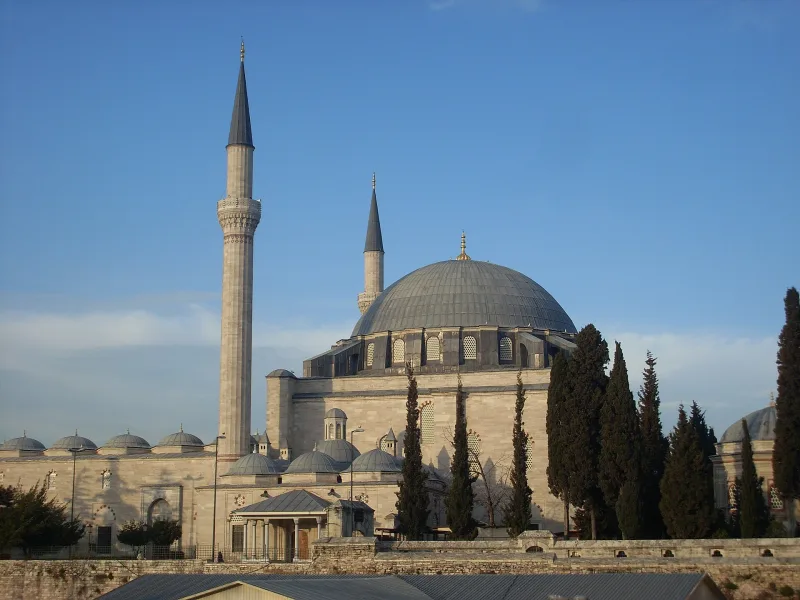

The Yavuz Selim Mosque—a stern guardian of Istanbul’s fifth hill overlooking the Golden Horn
The Yavuz Selim Mosque stands atop Istanbul’s fifth hill in the Çukurboğan district, and its silhouette over the Golden Horn is recognizable from afar: a solitary, squat dome, two slender minarets, and a long shadow cast upon the water. It is the second oldest of the city’s surviving imperial mosques, and one immediately senses the character of its patron—Suleiman the Magnificent erected it in memory of his father, the formidable Sultan Selim I, known as Yavuz—“the Terrible.” The Yavuz Selim Mosque lacks the external splendor of later Selatin mosques: there are no cascades of half-domes, as in the Süleymaniye, nor a colorful facade, as in the Blue Mosque. Instead, it offers a rare sense of early Ottoman austerity, Iranian tilework, the tranquility of the courtyard with its plane trees, and a view that alone makes it worth climbing up here at least once.
History and Origin of the Yavuz Selim Mosque
Selim I, Suleiman’s father, died in 1520. His reign was brief—just eight years—but transformed the Ottoman state into a transcontinental empire: Selim annexed Syria, Egypt, and the Hejaz, and brought the title of Caliph and the relics of the Prophet to Istanbul. The son, who inherited this unprecedented legacy from his father, decided to immortalize it with a monument on the Fifth Hill—one of the most prominent points in the city’s landscape.
Construction was entrusted to the architect Alauddin, also known as Ajem Alisi (“Persian Ali”). Work proceeded rapidly by the standards of imperial construction projects of the time: Turkish sources cite 1522 as the date of construction, while Western researchers agree that the complex was finally completed in 1527/8. The name of Mimar Sinan, whom later attempts sought to associate with the project, has no connection to the mosque: in the year work began, Sinan had not yet been noticed by the court and did not have access to major commissions. It is all the more interesting that one of the türbes in the courtyard was indeed built by Sinan—but later, in 1556.
The mosque became the center of a külliye—an entire complex comprising a madrasa, an imaret (public kitchen), a caravanserai, and a bathhouse. Some of the structures have not survived to the present day, but the mosque itself and the türbe have weathered earthquakes, fires, and restorations of the 19th and 20th centuries. A Turkish guidebook notes that one side of the mosque overlooks the Aspar Cistern—the largest of Constantinople’s three Roman reservoirs—while the other drops down to Kırk Merdiven Street, “Forty Steps.” This topography still makes the approach to the mosque a bit of an adventure today.
Architecture and What to See
Externally, Yavuz Selim gives the impression of ascetic austerity: its plan is a simple square, covered by a single dome, without the complex system of half-domes that later imperial mosques boast. This is a rare example in Istanbul of an early Ottoman architectural concept on an imperial scale.
The courtyard, portico, and three gates
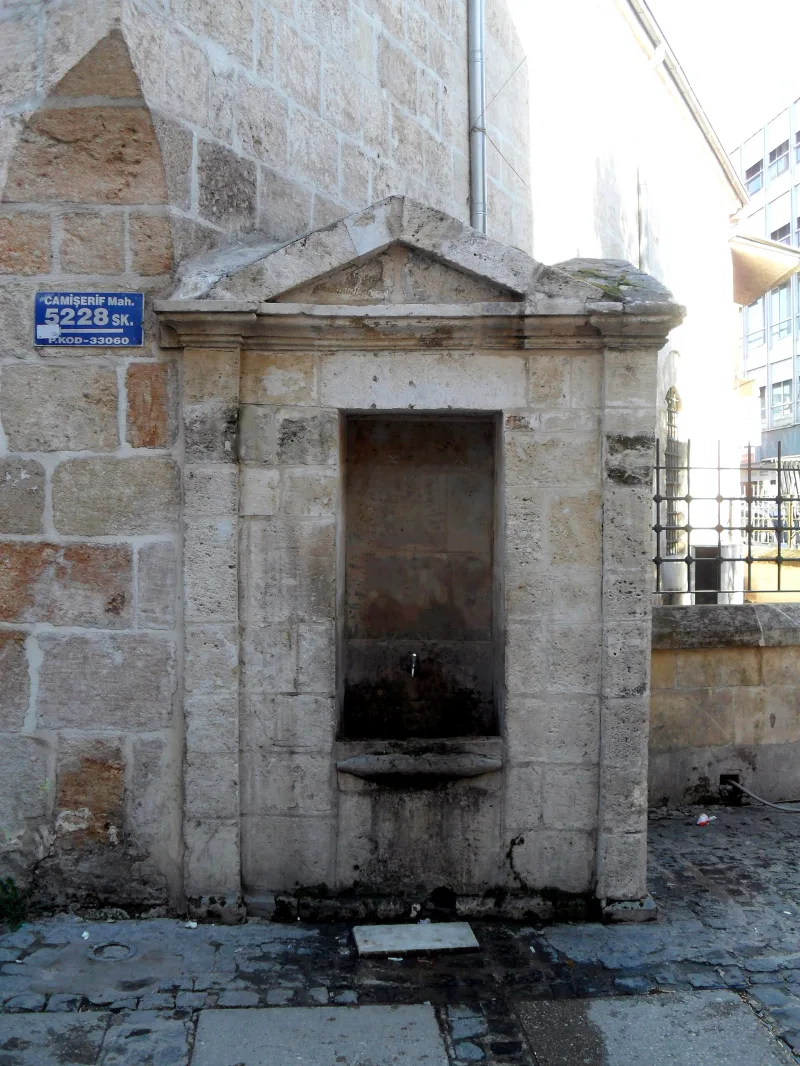
Three gates lead into the large courtyard (avlu): Türbe Kapısı (from the tombs), Çarşı Kapısı (from the bazaar), and Kırk Merdiven Kapısı (from the cliff). The courtyard is spacious and shady, with old trees and a şadırvan—a marble ablution fountain said to have been erected by Sultan Murad IV. The colonnade of the Last Assembly (son cemaat yeri) rests on 18 columns and is covered by 22 small domes; the columns are of various materials—marble, granite, porphyry—and this motley “collection” of spolia lends the courtyard a distinctive rhythm.
The main dome and the proportions of the hall
The prayer hall is a simple square room with a side length of 24.5 meters, crowned by a shallow dome 32.5 meters high. The dome rests directly on the four walls, without the use of half-domes—a technique dating back to the early Ottoman mosques of Bursa and Edirne. Like Hagia Sophia, the dome here is much flatter than a hemisphere, and because of this, the space appears not vertical but horizontal, spreading out.
Cuerda seca tiles—an Iranian style
The main interior decoration consists of lunette panels above the windows, executed in the cuerda seca technique: colored tiles where different glazes are separated by a thin, bold line that prevents the colors from blending during firing. These panels were almost certainly made by the same Iranian masters who decorated the Sünnet Odası—the circumcision room in Topkapı Palace. No other mosque in Istanbul features this particular “Iranian” shade of tile: later, the Ottomans would prefer Iznik ceramics with their famous crimson hue.
The Hünkar Mahfil and the Interior
To the left of the mihrab, supported by eight marble columns, stands the sultan’s box (hünkar mahfili); to the right is the muezzin’s box, and another one above the qibla. The marble minbar, as well as the window and door panels, are adorned with carvings, mother-of-pearl inlays, and ivory; the calligraphy, gilding, and painting (nefesh and tezhip) are executed at the highest level of their time. Turkish guidebooks particularly note the beauty of the tiles around the mihrab—“such an ensemble exists only in this mosque.”
The Tomb of Selim I and the Garden Behind the Mosque
Behind the mosque, on a terrace overlooking the Golden Horn, stands the octagonal türbe of Sultan Selim I, completed in 1523. Its architect was the same Adjem Ali. The small porch of the türbe is entirely clad in tiles with a unique pattern; inside, there are double-tiered windows, four colored columns, five arches, and a sarcophagus with a selimi-kavuk (a characteristic Ottoman turban). Above the door, a verse is inscribed in calligraphy: “Every soul shall taste death.” The ebony doors are decorated with mother-of-pearl inlay. Nearby stands a second turbe from 1556, attributed to Mimar Sinan: it houses the tombs of three sons of Suleiman the Magnificent—Mahmud, Murad, and Abdullah—and two daughters of Selim I, Hafize Hafsa and Hatice. The third tomb belongs to Sultan Abdul-Mejid I and was built shortly before his death in 1861.
Interesting facts and legends
- According to legend, a caftan belonging to the scholar Ibn Kemal lay on Yavuz Selim’s sarcophagus: once, while riding alongside him, the sultan splashed mud on his caftan—and was so impressed by the scholar’s dignity that he bequeathed that garment to be placed on his own coffin.
- Selim I ruled for only eight years, but during that time he nearly doubled the territory of the Ottoman Empire: his son Suleiman built a mosque for his father, whose nickname “Yavuz”—“the Terrible,” “the Merciless”—was both a warning and a compliment.
- Later attempts were made to replace the architect Adjem Ali—that is, “Persian Ali”—with Mimar Sinan in historical sources, but Sinan was not yet known to the court in 1522. The irony is that Sinan did eventually find a place in this complex—he built the shehzade’s türbe in 1556.
- The mosque stands precisely on one of Istanbul’s “seven hills,” and from its külliye at the summit of the fifth hill, it offers the best panoramic view of the Golden Horn—better than from many official observation decks.
- In the tomb’s garden, following Ottoman tradition, there is a small rose garden: it is believed that roses in Istanbul were first planted at imperial tombs in the 16th century.
How to get there
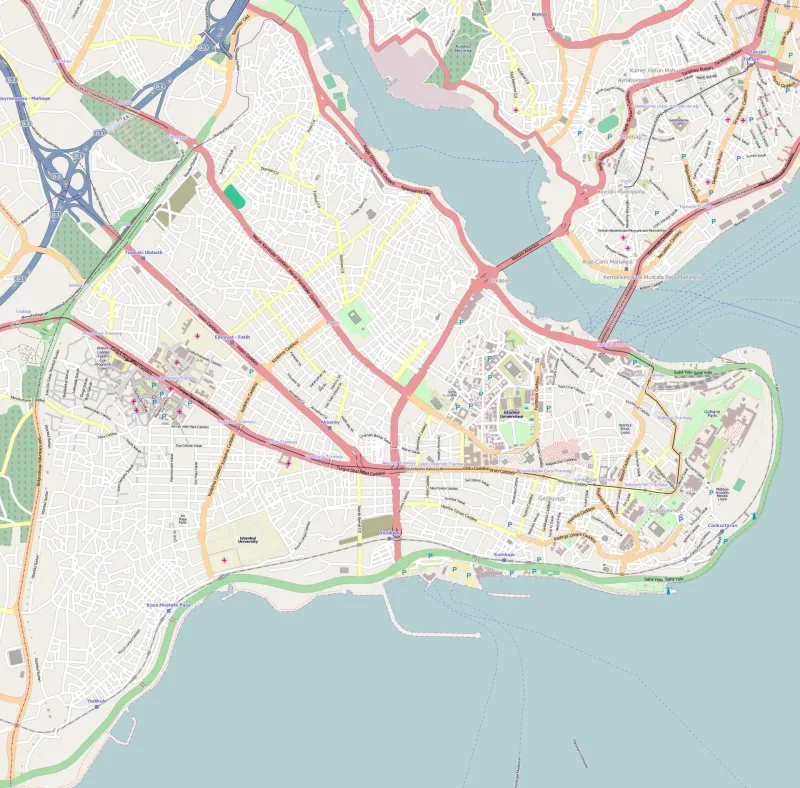
The mosque is located in the Fatih district, a few blocks north of Fevzi Pasha Avenue, on Yavuz Selim Caddesi. The most convenient way to get there is by taking the T1 tram to the Aksaray or Çapa-Şehremini stop, then transferring to bus 36KE, 87, or 90 toward Balat and get off at the Yavuz Selim stop. The walk up from Ayvansaray on the shores of the Golden Horn takes 15–20 minutes—a steep but picturesque path through the old wooden houses of the Balat and Fener districts.
From Istanbul Airport (IST), the most convenient way is to take the M11 metro to Kağıthane, then transfer to the M7 and take the T1 tram; total travel time is about 1 hour and 40 minutes. From Sabiha Gökçen Airport (SAW)—take the Havabus to Taksim and then a taxi across the Atatürk Bridge, about 1 hour. By car, Ferizade Caddesi leads to the mosque, but parking is limited: it’s better to leave your car at the Grand Bazaar or at Ayvansaray and walk up. Combine this trip with a walk through Balat and Fener—this is perhaps the most atmospheric walking route in old Istanbul.
Tips for travelers
The best time to visit is late spring (April–May) and early fall (September–October): the air is clear then, and from the turbe’s terrace you can see boats sailing down the Golden Horn far below. It’s hot in Istanbul in the summer, but it’s precisely at noon that the mosque’s dome, heated by the sun, casts a sharp, short shadow, making the interior cool and dark—it’s a great place to escape the Istanbul heat. In winter, the mosque courtyard is especially quiet, and the cuerda seca tiles reveal their textured relief in the side light.
This is an active mosque, and the rules are the same as at Hagia Sophia or Süleymaniye: women must cover their heads, shoulders, and knees; men must not wear shorts. Scarves are provided free of charge at the entrance, and shoes are placed in a plastic bag. During the five daily prayers, and especially on Friday at noon, the tourist entrance is closed—it’s best to plan your visit between the ezans, during the window from 10 :00 to 11 :30 or from 14 :30 to 16 :00. Allow 60–90 minutes to tour the mosque, the türbe, and the courtyard; photographers should allow more time.
Combine your visit into a single itinerary with the neighboring gems of Balat and Fener: the ancient Greek school Megale Scholeion (“Red School”), the cast-iron Bulgarian Church of St. Stephen on the shores of the Golden Horn, the Patriarchate, and Kariye (the Chora Mosque with its Byzantine mosaics). From the fifth hill, it’s easy to walk down to the water: the waterfront is lined with cafes and small fish restaurants serving fresh anchovies and balık ekmek. Bring water, comfortable shoes—the cobblestones in the area are steep and often paved with large stones—and a small bag for your shoes and a scarf. The Yavuz Selim Mosque isn’t Istanbul’s most touristy stop, and that’s its greatest gift: here you can experience the imperial 16th century without crowds or haste, left alone with the shadow of Sultan Yavuz, a view of the Golden Horn, and the ringing silence beneath the dome, which has stood on these four walls for nearly five hundred years.